Hierarchy view

OVERVIEW

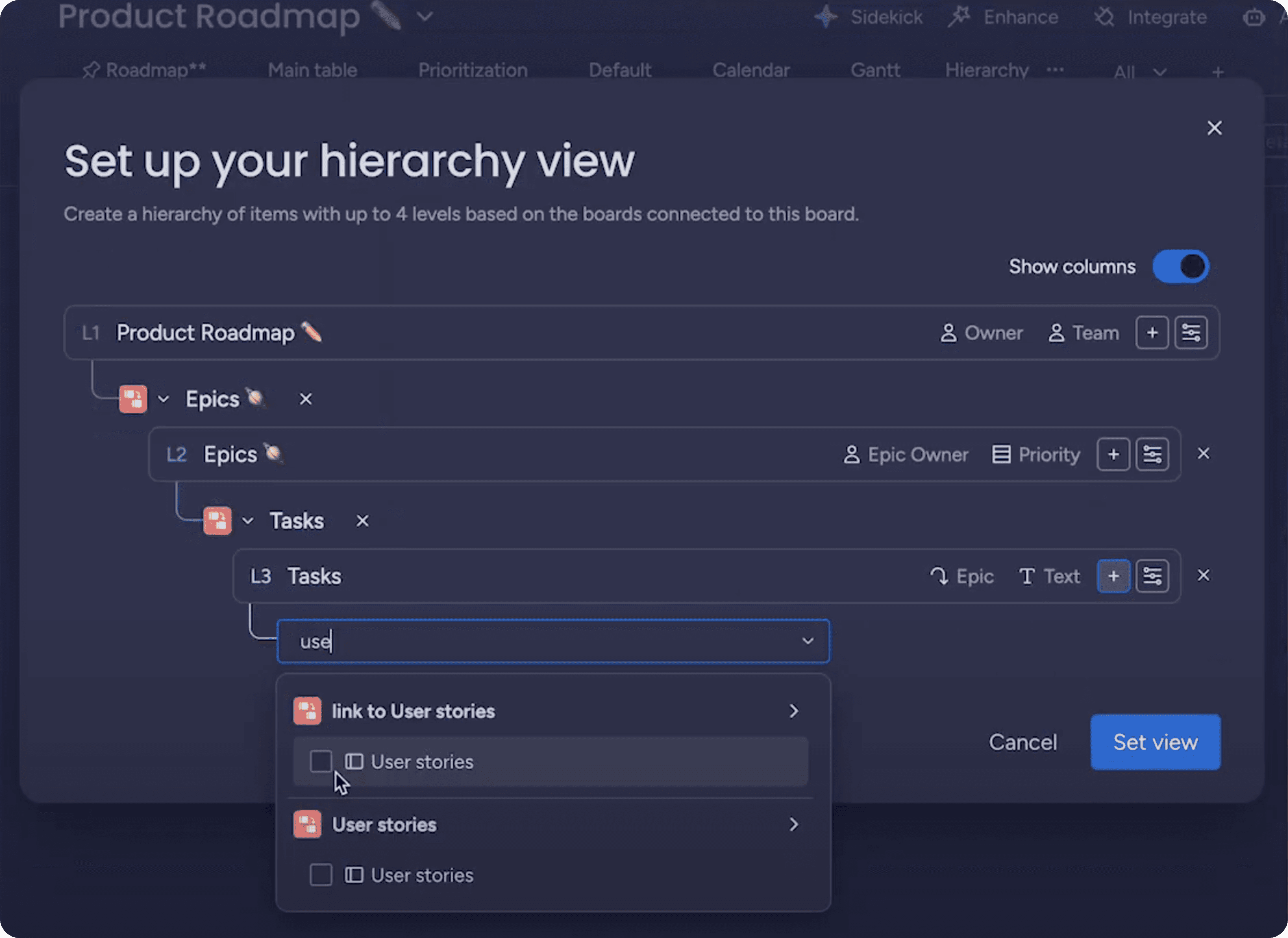
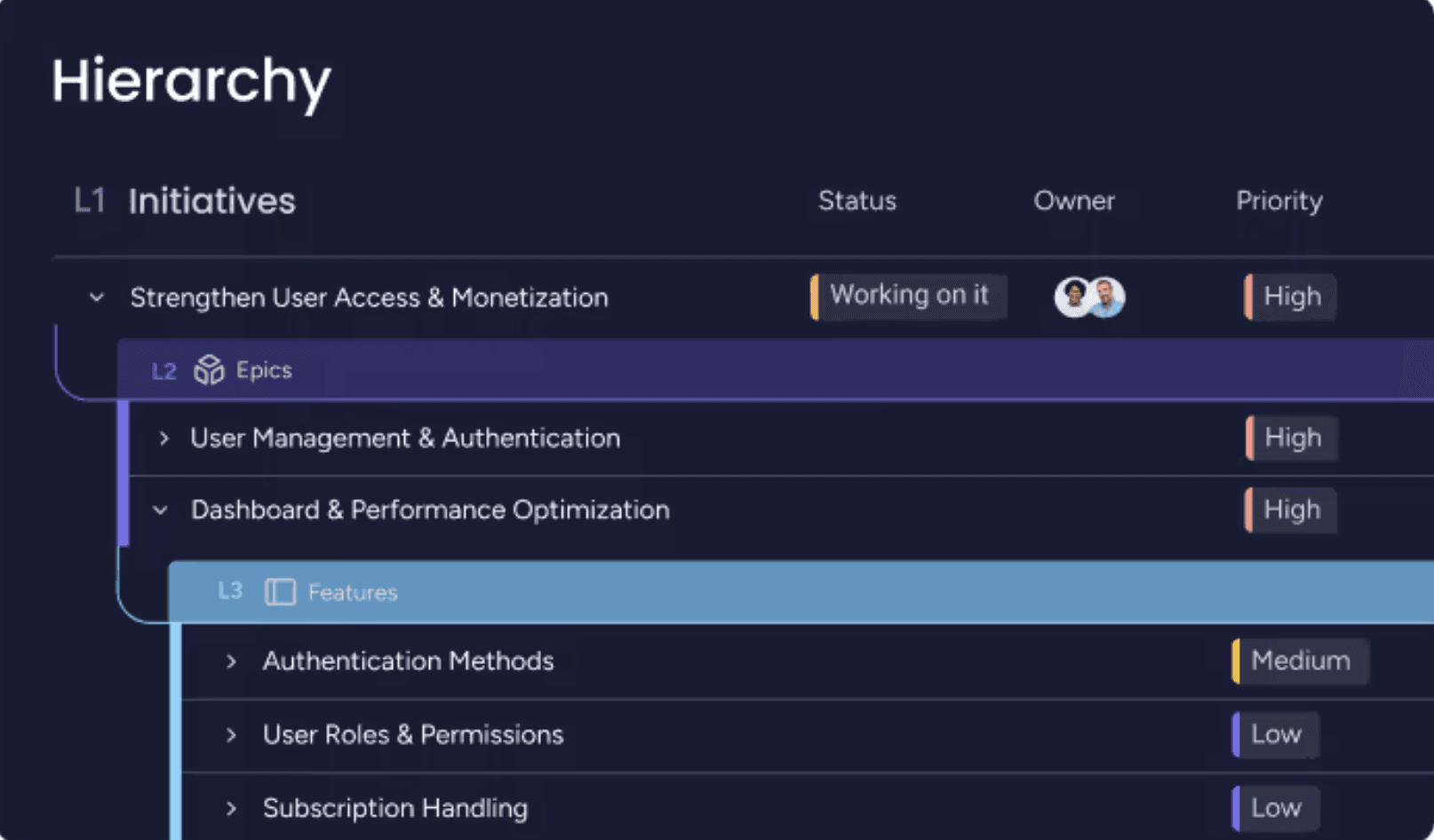
Hierarchy view is a multi-level planning experience I designed at monday dev to answer the top request from CROs and Enterprise customers: “let me see all related work in one place.” The project spanned an end-to-end process—from in-depth user interviews with a major global enterprise customer to translating complex technical requirements into an interface that lets teams plan, track, and update work across multiple linked boards. A core focus was reducing context switching and cognitive load. The initial concept evolved into a more familiar, sub-item-like experience that effectively creates a “mega board” – a single place where users can move fluidly from micro-tasks to macro initiatives without jumping between boards.

UI minimalistic widgets

The Challenge


Managers users struggled to manage hierarchical work across multiple boards, which led to:

  • Constant context switching between boards

  • Fragmented visibility from epics to tasks

  • Existing tools (like sub-items) that weren’t robust enough for multi-level, cross-board use cases

Solution

I designed a unified view that supports up to six levels of hierarchy, allowing users to:

  • Drill down from high-level Epics to granular Tasks in a single place

  • Navigate up and down the hierarchy without losing their place

  • Work with cross-board data as if it were one coherent structure

Impact

The feature became a “game changer” for Enterprise accounts and a key deal enabler in sales conversations.

  • A 46.1% retention rate showed that nearly one in two users who tried the feature continued using it regularly.

  • The interaction and structural design were strong enough to support a design patent filing.

Key Design Decisions

Visual hierarchy: Refined spacing, levels, and placeholders to reduce visual noise and make deep structures scannable.

  • Interaction model: Shifted from an accordion-style pattern to behavior that mimics sub-items, lowering the learning curve by building on existing mental models.

  • Smart automation: Enabled automatic linking of items created deeper in the hierarchy and allowed inline editing directly within the view, so users don’t have to jump out to other boards.

image of a smartphone leaning on top of a record player
UI minimalistic widgets

Hierarchy view

OVERVIEW

Hierarchy view is a multi-level planning experience I designed at monday dev to answer the top request from CROs and Enterprise customers: “let me see all related work in one place.” The project spanned an end-to-end process—from in-depth user interviews with a major global enterprise customer to translating complex technical requirements into an interface that lets teams plan, track, and update work across multiple linked boards. A core focus was reducing context switching and cognitive load. The initial concept evolved into a more familiar, sub-item-like experience that effectively creates a “mega board” – a single place where users can move fluidly from micro-tasks to macro initiatives without jumping between boards.
UI minimalistic widgets

The Challenge


Managers users struggled to manage hierarchical work across multiple boards, which led to:

  • Constant context switching between boards

  • Fragmented visibility from epics to tasks

  • Existing tools (like sub-items) that weren’t robust enough for multi-level, cross-board use cases

Solution

I designed a unified view that supports up to six levels of hierarchy, allowing users to:

  • Drill down from high-level Epics to granular Tasks in a single place

  • Navigate up and down the hierarchy without losing their place

  • Work with cross-board data as if it were one coherent structure

Impact

The feature became a “game changer” for Enterprise accounts and a key deal enabler in sales conversations.

  • A 46.1% retention rate showed that nearly one in two users who tried the feature continued using it regularly.

  • The interaction and structural design were strong enough to support a design patent filing.

Key Design Decisions

Visual hierarchy: Refined spacing, levels, and placeholders to reduce visual noise and make deep structures scannable.

  • Interaction model: Shifted from an accordion-style pattern to behavior that mimics sub-items, lowering the learning curve by building on existing mental models.

  • Smart automation: Enabled automatic linking of items created deeper in the hierarchy and allowed inline editing directly within the view, so users don’t have to jump out to other boards.

image of a smartphone leaning on top of a record player
UI minimalistic widgets

Hierarchy view

OVERVIEW

Hierarchy view is a multi-level planning experience I designed at monday dev to answer the top request from CROs and Enterprise customers: “let me see all related work in one place.” The project spanned an end-to-end process—from in-depth user interviews with a major global enterprise customer to translating complex technical requirements into an interface that lets teams plan, track, and update work across multiple linked boards. A core focus was reducing context switching and cognitive load. The initial concept evolved into a more familiar, sub-item-like experience that effectively creates a “mega board” – a single place where users can move fluidly from micro-tasks to macro initiatives without jumping between boards.

UI minimalistic widgets

The Challenge


Managers users struggled to manage hierarchical work across multiple boards, which led to:

  • Constant context switching between boards

  • Fragmented visibility from epics to tasks

  • Existing tools (like sub-items) that weren’t robust enough for multi-level, cross-board use cases

Solution

I designed a unified view that supports up to six levels of hierarchy, allowing users to:

  • Drill down from high-level Epics to granular Tasks in a single place

  • Navigate up and down the hierarchy without losing their place

  • Work with cross-board data as if it were one coherent structure

Impact

The feature became a “game changer” for Enterprise accounts and a key deal enabler in sales conversations.

  • A 46.1% retention rate showed that nearly one in two users who tried the feature continued using it regularly.

  • The interaction and structural design were strong enough to support a design patent filing.

Key Design Decisions

Visual hierarchy: Refined spacing, levels, and placeholders to reduce visual noise and make deep structures scannable.

  • Interaction model: Shifted from an accordion-style pattern to behavior that mimics sub-items, lowering the learning curve by building on existing mental models.

  • Smart automation: Enabled automatic linking of items created deeper in the hierarchy and allowed inline editing directly within the view, so users don’t have to jump out to other boards.

image of a smartphone leaning on top of a record player
UI minimalistic widgets

Interested to work with me?
edenzelivansky@gmail.com

2:37:34 PM

Interested to work with me?
edenzelivansky@gmail.com

2:37:34 PM

Interested to work with me?
edenzelivansky@gmail.com

2:37:34 PM